






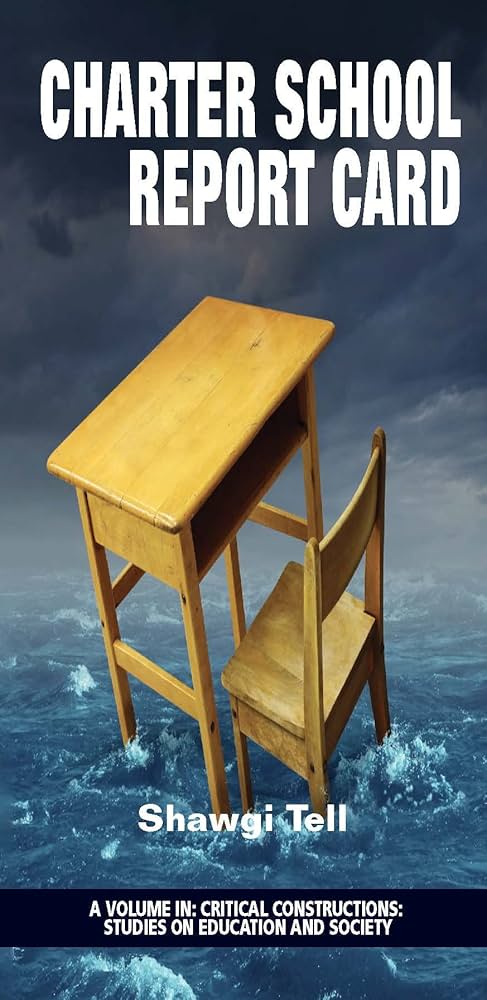
 Charter schools are deregulated private entities that embrace “free market” ideology. They rest firmly on consumerism, competition, and the medieval view that every individual should fend for themselves. Winning and losing are considered normal, healthy, and desirable in this obsolete outlook where “shopping for a school and hoping for the best” replaces the right to education.
These outsourced “schools” have been around since 1991. They make a few people quite rich, are usually more segregated than traditional public schools, and are also well-known for poor accountability, widespread corruption, and high student, teacher, and principal turnover rates that undermine a modern teaching and learning culture. See here for dozens of other differences between public schools and charter schools.
While many charter schools failed, closed, and abandoned thousands of people two to three decades ago, in recent years it has become a full time job to report on the number of old and new charter schools failing, closing, and leaving many out in the cold. The rate and tempo of non-profit and for-profit charter school failures and closures has now conditioned researchers, writers, journalists, and commentators to not let their guard down for a second because the next, typically sudden and abrupt, charter school failure and closure is right around the corner. A high level of predictability for failure and closure has now been solidified. Uncertainty and bedlam have increased qualitatively and quantitatively in the charter school sector.
In such a frenzied context, charter school disinformation, propaganda, and gas-lighting lose much of their power. Top-down neoliberal narratives collide more severely with harsh realities and hold less sway. Social consciousness of what is really happening begins to gradually increase.
The National Center for Charter School Accountability (NCCSA) states that, “Today, the charter sector stands at a reckoning point. Growth has slowed. For-profit models are expanding. The push to create religious charter schools has fractured the movement from within. Meanwhile, charters are now competing not just with public schools and each other, but with a growing network of voucher-funded private schools and publicly subsidized home-schools.”
The NCCSA also reminds us that, “In the first half of 2025, 50 charter schools announced plans to shut down. Some would close immediately, while others would remain open through the end of the school year.”
In a separate, more recent report, the same organization also reminds us that,” Scandals and closures have tarnished the charter brand resulting in mounting public disillusionment with charter schools — even among progressive policymakers who once embraced the idea. The 2025 Kappan poll illustrates this dramatic shift: in 2013, nearly seven in ten Americans (68%) supported charter and lab schools. By 2025, support had plummeted to just 46% — a22-point drop during a period when general support for school choice has reached record highs.” While this is a big drop, it is not unreasonable to assume that a more investigative survey would show even lower support for charter schools. Experience shows that when open, calm, honest, and deep discussion takes place with people, especially on a one-on-one basis, many people, including charter school employees, operators, and supporters, admit that charter schools have 50 problems and that society does not need to privatize schools because society can actually do much better. People crave coherence and analysis, and are eager to overcome disinformation and propaganda.
A recent alarming example of yet another charter school to close suddenly and abruptly, leaving everyone shocked and appalled again, comes from Orlando, Florida which already has a high rate of charter school failures and closures.
The title of the January 2, 2026 article says it all: “Families scramble to find new schools after Orlando charter school’s abrupt closure.” “Unsustainable financial challenges” was the main reason cited for the closure of Legends Academy Charter School. This is actually a common problem in the charter school sector which receives billions of dollars in public funds every year from the federal government and state governments, not to mention hundreds of millions of dollars a year from “philanthrocapitalists” and other private funders. Charter School Scandals is a website that regularly documents embezzlement, racketeering, and a range of other crimes, scandals, and controversies in the crisis-ridden charter school sector.
Legends Academy Charter School has been around for nearly 25 years and the unexpected closure will affect 200 families. Shocked and angry parents now have to frantically and urgently fend for themselves again to find another school for their kids in an education landscape that has become more chaotic over the years due to school privatization schemes imposed on the public in the name of “choice.” Angela Gillenwaters said she “doesn’t know where her 7-year-old grandson King will finish first grade.” She said, “My heart is crushed.” Speaking to the abrupt nature of the school’s closure and the lack of accountability routinely and casually demonstrated by school leaders in such horrible cases, Gillenwaters went on to say, “They weren’t answering any questions about where the funds and stuff like that…This isn’t something you just find out in one day. That’s impossible.” Another news source points out that, “For the families affected, the closure is much more than a mere logistical inconvenience. It signifies the dismantling of a community and a severing of plans for continuity in education.” Many teachers and education support staff will also become jobless because of the school’s sudden closure.
Sadly, this tragic scenario will be played out every week in the charter school sector in 2026. Even more disturbing is the outdated view of many charter school owners and operators who treat education as a commodity instead of a right and social responsibility. Such individuals nonchalantly repeat that schools are businesses and like any business they should be closed when they fail and someone smarter should show up and start a more successful business/school. Such a socially irresponsible view speaks volumes about those dominating education through the seizure of more state mechanisms and agencies.
Fortunately, many students abandoned by failing charter schools operated by unelected private citizens are able return to their host traditional public school district which, unlike charter schools, accepts all students at all times. Of course, these public schools will continue to be demonized, starved of funds, and set up to fail by neoliberals and privatizers determined to create charter schools that enrich them in the name of “choice” and “saving the kids.”
The public should not doubt its ability to combat all forms of privatization. Privatization causes many of the same problems no matter which sector, sphere, or country it invades, whether it is education, healthcare, electricity production, garbage collection, transportation, parking meter reading, airports, or railroads. Privatization is a major problem confronting everyone everywhere, not just those in the sphere of education.
In this age of fifth generation warfare, it is more critical than ever for everyone to engage in deep and sustained investigation and discussion and to make sure action and analysis go together. People are fed up with disinformation repeated endlessly as historical truth and desire facts, data, information, and analysis that opens the door to the progress of society.
Everything constantly changes, moves, and develops through contradictions, which means openings and opportunities to create the new, fresh, and modern will present themselves. Together we can seize these occasions to individually and collectively move society forward and restore education as a public responsibility, not a consumer good. It can be done.